
Blog
The Benjamin Bloom 2 Sigma Problem: A Game-Changer in Education

According to Bloom’s study, students in one-on-one tutoring scored higher than 98% of the students in a traditional classroom.
Overview
In today’s fast-paced educational world, ensuring each student receives the attention and resources they need is crucial for fostering academic success. One of the most effective ways to achieve this is through one-on-one tutoring, which provides tailored support for students to master subjects at their own pace. Research — including the famous 2 Sigma Problem by Benjamin Bloom — has shown that personalized, one-on-one tutoring can significantly enhance student performance, often yielding exceptional results.
The Benjamin Bloom 2 Sigma Problem: A Game-Changer in Education
In a groundbreaking 1984 study, educational psychologist Benjamin Bloom discovered that students who received personalized, one-on-one tutoring performed far better than their peers in traditional classroom settings. In his study, Bloom compared the performance of three groups of students: those taught through conventional classroom instruction, those who received small-group instruction, and those who received individualized tutoring.
Bloom’s findings were nothing short of revolutionary. He concluded that students who received one-on-one tutoring performed at a level two standard deviations — or “2 sigmas” — above their peers. In simpler terms, tutoring enabled students to outperform the vast majority of students in traditional settings, placing them well above the average student’s performance.
The data behind the 2 Sigma Problem
To illustrate the difference:
- Traditional classroom instruction: a group of students working in a traditional classroom setting, roughly a 1:30 teacher-to-student ratio.
- One-on-one tutoring: a student working individually with a tutor, receiving personalized instruction that caters to their unique needs and learning style.
- Results: according to Bloom’s study, students in the one-on-one tutoring group scored higher than 98% of the students in the traditional classroom.
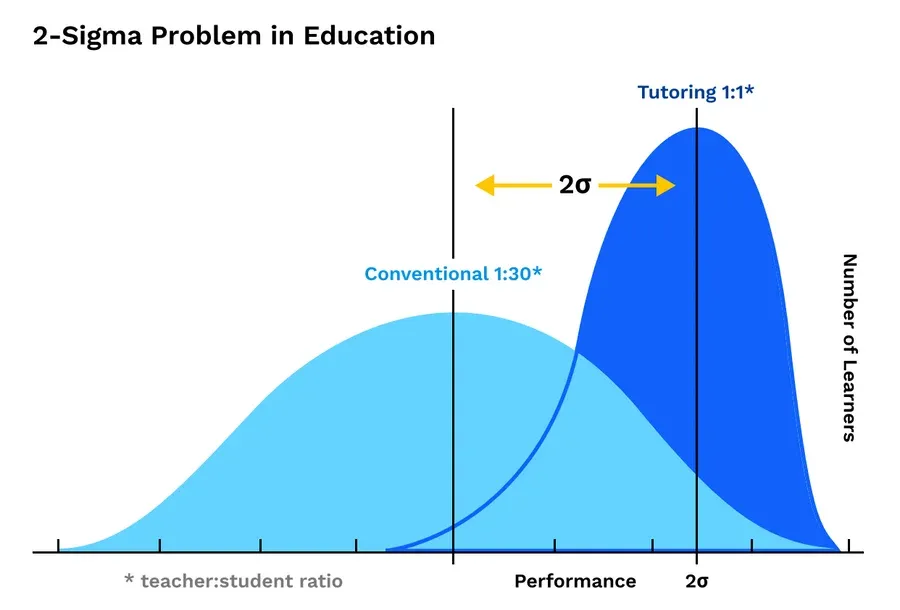
“+2 Standard Deviations” means students performing at a level higher than 98% of their peers in traditional settings. Chart source: IEEE Spectrum.
This gap in performance is significant, showcasing the effectiveness of personalized tutoring.
Other research supporting one-on-one tutoring
Bloom’s research wasn’t the only study to highlight the effectiveness of one-on-one tutoring:
- National Bureau of Economic Research (NBER): found that students who received personalized tutoring were more likely to perform better on standardized tests and had improved long-term academic outcomes.
- U.S. Department of Education: a comprehensive study found that students who received one-on-one tutoring consistently outperformed their peers across academic subjects, including math and reading.
Why does one-on-one tutoring work?
- Personalized attention. Students get direct, immediate feedback on their work — they can ask questions, clarify doubts, and get explanations tailored to their learning style.
- Pacing and flexibility. Each student learns at their own pace, spending more time on challenging topics and moving quickly through areas they already understand.
- Targeted instruction. Tutors identify a student’s strengths and weaknesses from the start and focus on where the student needs the most improvement.
- Increased confidence. Personalized instruction builds student confidence as they master concepts they previously struggled with, creating a positive feedback loop of achievement.
- Minimized distractions. Without classmates or a fixed group pace to contend with, students can focus entirely on the subject matter.
How this shows up in today’s education
Whether it’s preparing for high-stakes exams like the SAT, ACT, or AP exams, or mastering challenging subjects like math, science, English, or world languages, one-on-one tutoring offers a personalized approach that helps students build a strong academic foundation for long-term success.
Conclusion
The results from Benjamin Bloom’s 2 Sigma Problem, along with the research that followed it, point to one key finding: personalized, one-on-one tutoring can significantly boost student performance. It’s why more parents are turning to 1:1 tutoring to give students an academic edge. Want to see it in practice? Book a free demo class and meet your tutor.